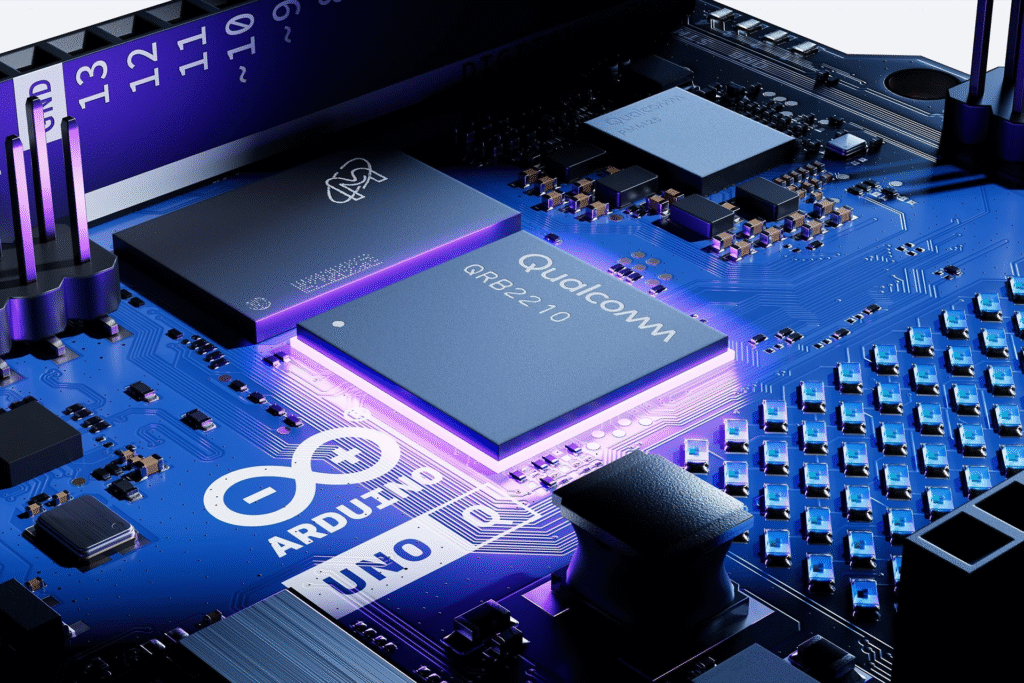
In a move that has taken both the developer and hardware communities by surprise, Qualcomm has officially acquired Arduino, one of the world’s most recognized open-source hardware brands. As part of the announcement, Qualcomm introduced the UNO Q, a next-generation microcontroller platform that fuses Arduino’s maker-friendly ecosystem with Qualcomm’s powerful wireless and AI-on-the-edge technology.
The acquisition, first reported by The Verge, marks a new chapter for Arduino — shifting the company from its grassroots electronics origins into the realm of advanced Internet of Things (IoT) development. For Qualcomm, it’s a strategic expansion into a fast-growing segment where the lines between consumer devices, automation, and AI-driven hardware continue to blur.
From Hobby Projects to Industrial Power
Founded in 2005, Arduino built its reputation by making electronics accessible. Its boards powered countless hobbyist and educational projects, forming the backbone of the maker movement. Qualcomm’s interest brings that legacy into the enterprise age, merging open-source development with the company’s expertise in connectivity, 5G, and AI.
The new Arduino UNO Q board reflects this union. It’s built around a custom Qualcomm chipset featuring integrated Wi-Fi 7 and Bluetooth 5.4, alongside a dedicated neural processing engine for running machine learning models locally. That means developers can deploy real-time AI applications — from voice recognition to sensor fusion — without relying on cloud connectivity.
In practice, the UNO Q could bridge a gap between consumer experimentation and industrial use, providing an accessible yet powerful platform for developing edge-based smart systems.
A New Direction for Arduino
For Arduino, the acquisition marks both an evolution and a delicate balancing act. The company has long prided itself on openness — an ethos that attracted millions of educators, students, and independent developers. Integrating into Qualcomm’s ecosystem raises questions about how much of that openness can be preserved.
In an official statement, Arduino’s founders emphasized that the brand’s “commitment to accessibility and open-source values remains unchanged.” However, industry observers note that the move will likely introduce new layers of licensing and certification, especially as Qualcomm targets professional and commercial developers.
The merger could transform Arduino’s image from a maker hobby tool into a key component of Qualcomm’s broader IoT and AI strategy, connecting billions of devices across industries such as automation, smart homes, and wearables.
Qualcomm’s Expanding Edge
Qualcomm has been steadily diversifying beyond smartphones, focusing on edge computing, automotive systems, and embedded AI. The acquisition of Arduino accelerates that push, giving the company an established developer community and a recognizable brand in education and prototyping.
The UNO Q board fits squarely within Qualcomm’s plan to unify development across its ecosystem. It allows software engineers to design and test AI models using Qualcomm’s SDKs before deploying them onto compatible chipsets for commercial products.
Executives at Qualcomm described the new board as “a bridge between the imagination of makers and the precision of industrial AI,” underscoring its role as a crossover tool.
The UNO Q: Specs and Features
While full technical specifications are still emerging, early details suggest the UNO Q offers a significant leap over traditional Arduino boards. Highlights include:
-
Qualcomm Snapdragon QX2 microcontroller with integrated NPU for on-device AI
-
Wi-Fi 7 + Bluetooth 5.4 for advanced connectivity
-
Edge AI SDK support for computer vision and audio processing
-
USB-C interface, microSD storage, and expanded GPIO compatibility
-
Low-power adaptive modes for energy-efficient operation
Developers can expect compatibility with existing Arduino libraries, though advanced features will rely on Qualcomm’s proprietary toolkits.
A Shift in the Maker Landscape
Arduino’s acquisition by a tech giant like Qualcomm marks a turning point for the open-source hardware movement. Some developers see it as validation — proof that grassroots innovation can scale to industrial relevance. Others worry that commercialization could dilute the simplicity and freedom that defined Arduino’s early years.
The reaction among educators and makers has been mixed. Many welcome the promise of higher performance and broader wireless capabilities, while others question whether Qualcomm will maintain support for the educational programs and low-cost hardware that made Arduino ubiquitous in classrooms and workshops.
Looking Ahead
Both companies are framing the merger as a partnership between innovation and infrastructure. The first UNO Q boardsare expected to ship to developers in early 2026, with full availability later that year. Qualcomm says the acquisition will not affect the existing Arduino Cloud or legacy product support, at least in the near term.
As the boundaries between DIY electronics and industrial IoT continue to fade, the Qualcomm–Arduino alliance could reshape how intelligent devices are built, tested, and deployed. Whether it strengthens or complicates Arduino’s grassroots legacy will depend on how well Qualcomm honors the community that made it a household name in the first place.